Overview
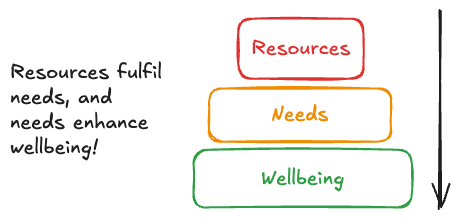
In this module focus, the fundamental concepts of resource management are explored. These concepts include wellbeing (how well a person’s needs are met and how fulfilled they are), needs (essentials for life), and resources (things used to satisfy needs).
Tip
Consider completing the ‘Students Learn To’ blocks as questions for each dot point to apply your knowledge after reading.
Wellbeing
Students Learn To
▪ explore the concept of wellbeing by considering the following questions:
– what is the opposite to wellbeing?
– how do people describe wellbeing?
– why might there be different understandings of wellbeing?▪ analyse the relationship between the factors and explain how they can impact on wellbeing
▪ discuss the effect that their own wellbeing can have on the wellbeing of the groups to which they belong
Defining Wellbeing
Definition
Wellbeing is how well a person’s needs are met and how satisfied and fulfilled they are”. This definition of wellbeing is interpreted differently due to different person factors such as different beliefs, perspectives, and levels of education.
Factors Affecting Wellbeing
Within the Community and Family Studies course, the concept of wellbeing is deeply explored, with various factors affecting a person’s sense of wellbeing.
These factors of wellbeing include:
- Social –> Interaction with others, e.g. leisure
- Physical –> Bodily and basic functions, e.g. sleep
- Economic –> Income, money, e.g. job security
- Emotional –> Feelings, e.g. attachment and bonding
- Cultural –> Customs, beliefs, values, e.g. identity and belonging
- Spiritual –> Morality, life outlook, e.g. ideals, aspirations, religious principles
Interrelation between the Factors of Wellbeing
These factors are heavily interrelated to each other. For example, someone going to the the gym five times a week can create negative economic impacts upon a person, but have great physical and social impacts on wellbeing.
The wellbeing of a person is also ever-changing and versatile.
Individual and Group Wellbeing
It can also be observed through an individual and group basis.
- The wellbeing of an individual considers their own needs first, with factors including good health, feelings of security, positive relationships, etc.
- Group wellbeing deals with concerns surrounding the needs of the collective (all people), aiming to improve individual wellbeing through resource access for the satisfaction of needs.
- Individual and group wellbeing are not mutually exclusive to another. However, an individual’s wellbeing and the group’s wellbeing can affect each other. For example, if a child’s parents are constantly yelling, the child may feel a negative impact on their emotional wellbeing.
Wellbeing can be measured in the following hierarchy, from lowest to highest.
- Satisfaction of needs
- Environmental comfort
- Effective communication
- Autonomy
Needs and Wants
Students Learn To
▪ describe each of the specific needs and compare the significance of each to different individuals
▪ critique Maslow’s hierarchy and debate its relevance and validity after considering contemporary views on human needs
▪ outline a specific need that is significant to them and explain how goal setting can contribute to the satisfaction of that need
Defining Needs and Wants
Definitions
Needs are essentials for life, and things that do not change overtime. If needs are not met, they can result in poor health outcomes. For example, if a person does not have food or water, it can lead to them becoming sick or dying.
Wants are non-essential items for life. They are individualistic desires that change overtime, and may lead to mental distress if they are not met (mental distress including disappointment and annoyance). For example, if a person is not able to receive the vinyl that they want to buy, they may feel upset or have a negative impact on their emotional wellbeing, but will not lead to adverse outcomes if not met.
Specific Needs
Every individual has the same six basic needs. These include:
- Safety and security –> having a safe and secure environment in a physical, emotional, and financial context
- Health –> having the minimum bodily function to work in society, such as being physically active and having good nutrition
- Education –> having the formal training in the knowledge and skills necessary to succeed in life
- Sense of identity –> self=understanding, feeling confident in their purpose in life
- Employment –> earning an income, which allows for independence, thus satisfying needs and wants
- Adequate standard of living –> primary needs (such as food for growth and development, clothing for extreme weather protection, and shelter for protection from danger), sustainable environments (clean air, surroundings, water), and lifestyle (adequate rest)
Different Need Prioritisation for Different Individuals
However, despite every individual having the same six needs, the prioritisation of these needs are dependent on their own individual circumstances.
- A young person may need to prioritise their sense of identity and education to help improve their wellbeing.
- Homeless people might need to prioritise their safety and security, adequate standard of living, and health, in order to have better wellbeing.
Maslow’s Hierarchy
Maslow’s Hierarchy
Developed in 1943, Abraham Maslow developed a theory that described and explained human motivation through five levels on a pyramid. This is an outdated theory that described individual’s specific needs.
However, Maslow’s hierarchy was critiqued for lacking scientific evidence, having a rigid structure (suggesting that needs MUST be met in a specific order), having cultural bias, being one-dimensional, and over-simplifying human motivation.
Satisfaction of Needs and Wants
Satisfaction of Needs and Wants
To satisfy needs and wants, people can set goals to provide an incentive to perform well and build self-esteem. These goals can be set through the SMART framework.
Specific
Measurable
Achievable
Relevant
Time-bound
Example
For example, a person can set a goal that follows this framework to be healthier over the next 8 weeks.
Maintain a consistent gym routine by doing 2 sets of arm exercises [relevant, specific, and measurable] for three days [measurable] over eight weeks [time-bound].
Example
Another example could be the following:
Get a Band 5-6 [relevant & specific] in all subjects by regularly studying [specific] every day [measurable] over the next two years [time-bound].
Resources
Students Learn To
▪ describe a range of resources and explain how they assist in satisfying specific needs
▪ propose how resources could be interchanged to enhance wellbeing in a variety of situations
▪ outline strategies individuals use to conserve human and non-human resources
Defining Resources
Definition
Resources are things people used to achieve goals (thus, to satisfy specific needs and wants), whether it be an object, person, idea, concept, skill, or quality that may assist in achieving these goals.
Specific Resources
Resources are split into human and non-human, formal and informal, and economic and non-economic resources. These types of resources can contribute to the specific needs of a person.
Tip
Human and non-human resources are the most important categories to remember.
Human and Non-Human
Human resources are intangible resources, such as skills, abilities, talents, knowledge, initiative, and etc. Non-human resources are tangible objects, such as computers, food, vehicles, and etc.
Relating to Specific Needs
A person’s creativity may contribute to their sense of identity. Similarly, food may help contribute to a person’s adequate standard of living.
Formal and Informal
Formal resources are resources organised by the community, usually with a formal leadership system and set hours of operation. Informal resources are vice versa, and do not require a formal leadership system or set hours of operation, and thus, are available informally.
Relating to Specific Needs
Pre-schools and libraries are formal resources, fulfilling needs such as education. Family and friends are informal resources, allowing for the fulfilment of needs such as safety and security.
Economic and Non-Economic
Economic resources are resources used to achieve economic gain or complete economic goals. Non-economic resources are vice versa, and are non-financial resources.
Relating to Specific Needs
Income (welfare) and property wealth are economic resources, helping with needs such as safety and security. Communication skills and energy are non-economic resources, assisting with needs such as employment and education.
Other
Tip
Resources can also be looked through the perspective of the following categories:
- Personal (human)
- Interpersonal (human)
- Money (non-human)
- Material possessions (non-human)
- Natural environment (non-human)
- Global (human & non-human)
- Community (human & non-human)
Interchangeability of Resources
Resources can be exchanged or interchanged, such as a time-poor worker exchanging their money (a non-human resource) for a house cleaner, which requires skills (a human resource).
Most scenarios of resource interchangeability will enhance wellbeing through the development of a people’s sense of identity and social connections. It will also allow for the accessibility of other resources, which will also enhance wellbeing.
Example Scenarios
- Doing chores around the house for money: skills and time (human) –> money (non-human)
- Enhances individual wellbeing (money for savings)
- Enhances group wellbeing (parents don’t need to spend too much time)
- Driving lessons from parents in exchange for babysitting: knowledge and time (human) –> knowledge (human)
- Enhances individual wellbeing (learning new skills, enhancing sense of identity)
- Enhances group wellbeing (saved time and service from parents)
- University degree in part-time as a sole parent: time (human) and money (non-human) –> education (human)
- Enhances individual wellbeing (learning new skills, fulfilling needs such as education and sense of identity, as well as supporting economic and emotional wellbeing)
- Enhances group wellbeing (more opportunity for employment to support family, fulfilling needs such as employment)
Resource Sustainability
In regards to the field of resource sustainability, there are basic concepts that must be established:
- Resources must be sustained or conserved.
- Individuals are the consumers of resources.
- Resources can be split into two more categories, renewable and non-renewable.
Strategies to Sustain Resources
| Resources (Human and Non-Human) | Strategies |
|---|---|
| Intelligence | Use technology, read and write, go to school |
| Money | Budget and invest |
| First aid skills | Join courses, review, practice |
| Water | Repurposing water, timed usage, and use sustainability taps |
| Cooking | Receive knowledge from parents and culture, practice cooking |
| Roads | Council repairs, restrictions, and roadwork |